
Writing a non-fiction book is a major accomplishment. Whether you’re creating a self-help guide, business book, memoir, educational resource, or industry-focused manuscript, completing the first draft is only the beginning.
Many authors make the mistake of jumping directly to proofreading, believing grammar corrections alone will prepare their manuscript for publication. In reality, even a grammatically flawless manuscript can fail if the structure, clarity, and content flow are weak.
That’s where developmental editing for non-fiction books becomes essential.
At Vivion Editing, we work with authors who want more than just error-free writing. We help transform manuscripts into compelling, professionally structured books that engage readers and build credibility.
In this article, you’ll learn why developmental editing should always happen before proofreading — and how it can dramatically improve your book’s success.
What Is Developmental Editing for Non-Fiction Books?
Developmental editing focuses on the big-picture elements of your manuscript rather than sentence-level corrections.
A developmental editor evaluates:
- Book structure
- Chapter organization
- Clarity of ideas
- Reader engagement
- Logical flow
- Content gaps
- Repetitive sections
- Tone consistency
- Audience alignment
Unlike proofreading, developmental editing ensures your manuscript actually works for readers before it gets polished.
Example:
Imagine writing a business book filled with valuable insights, but the chapters feel disconnected and repetitive. A proofreader might correct punctuation, but a developmental editor reorganizes the content so readers can follow your ideas effortlessly.
That’s the difference between a readable book and a professional-quality book.
Why Proofreading Alone Won’t Fix Your Manuscript
Proofreading is the final editing stage. It focuses on surface-level issues like:
- Grammar mistakes
- Typos
- Punctuation
- Formatting inconsistencies
- Spelling errors
However, proofreading cannot solve deeper manuscript problems such as:
- Weak chapter flow
- Confusing arguments
- Poor pacing
- Lack of clarity
- Audience disconnect
- Repetition
- Missing explanations
If your manuscript has structural issues, proofreading simply polishes the problems instead of fixing them.
At Vivion Editing, we often see authors invest in proofreading first, only to realize later that their manuscript still feels “off.” Developmental editing addresses the foundation before final polishing begins.

Why Developmental Editing Matters for Non-Fiction Authors
Non-fiction readers expect value, clarity, and organization. They read your book to solve problems, learn new concepts, or gain expert insights.
If your manuscript feels confusing or poorly structured, readers may stop reading — even if the content itself is valuable.
Developmental Editing Helps You:
Improve Reader Experience
A well-structured book keeps readers engaged from beginning to end.
Build Author Credibility
Professional organization makes your expertise more trustworthy.
Clarify Complex Ideas
Editors help simplify technical or complicated concepts for better understanding.
Eliminate Redundancy
Repeated ideas weaken your message and frustrate readers.
Create a Strong Narrative Flow
Even non-fiction books need smooth transitions and logical progression.
At Vivion Editing, our goal is to ensure your message connects clearly with your audience while maintaining your unique voice.
Signs Your Book Needs Developmental Editing
Many authors don’t realize their manuscript needs developmental editing until beta readers point out problems.
Your non-fiction book likely needs developmental editing if:
- Chapters feel disconnected
- Readers become confused
- Your ideas repeat too often
- The structure feels messy
- Some chapters feel too long or too short
- Your target audience isn’t clearly defined
- The manuscript lacks flow
- You changed direction while writing
These are common issues — and they’re exactly what developmental editing is designed to solve.
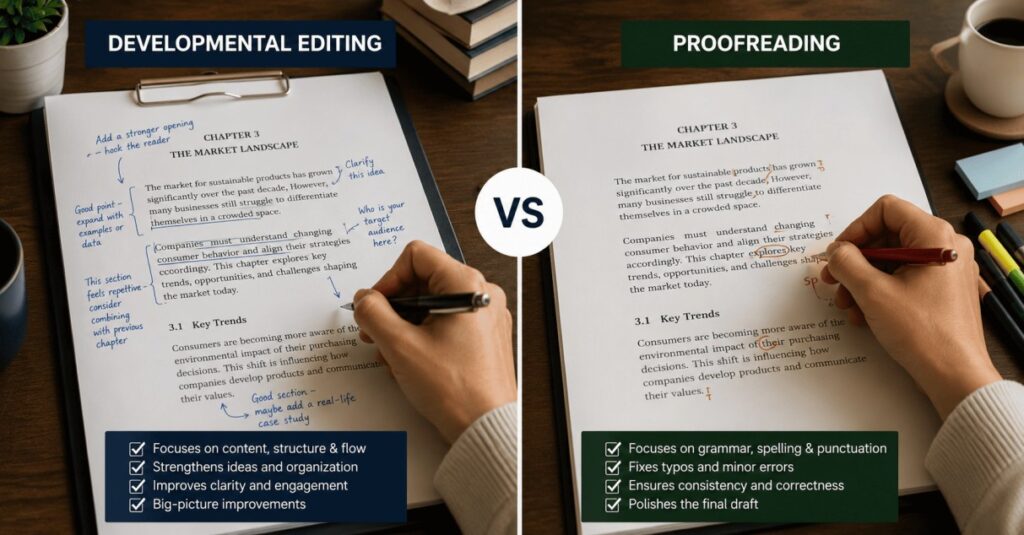
Developmental Editing vs. Proofreading: Understanding the Difference
Many writers confuse developmental editing with proofreading, but they serve completely different purposes.
| Developmental Editing | Proofreading |
|---|---|
| Focuses on content structure | Focuses on grammar |
| Improves organization | Fixes typos |
| Strengthens clarity | Corrects punctuation |
| Enhances reader engagement | Checks formatting |
| Happens early in editing | Happens last |
Simple Analogy:
Developmental editing builds the house. Proofreading paints the walls.
Without a strong foundation, even the best proofreading won’t save the book.
How Developmental Editing Increases Book Sales
Many authors overlook the direct connection between editing quality and sales performance.
Readers today have endless options. Poorly structured books quickly receive negative reviews, which impacts:
- Amazon rankings
- Reader trust
- Word-of-mouth referrals
- Author reputation
- Conversion rates
A professionally edited manuscript improves readability, engagement, and reader satisfaction — all of which contribute to better reviews and increased sales.
At Vivion Editing, we help authors create books that not only read professionally but also position them as credible experts in their industry.
Why Self-Published Authors Need Developmental Editing Most
Traditional publishing houses usually provide multiple editing stages before publication. Self-published authors must manage this process independently.
That’s why developmental editing for non-fiction books is especially important for independent authors.
Without professional guidance, self-published books often suffer from:
- Poor structure
- Weak transitions
- Inconsistent tone
- Unclear messaging
- Reader confusion
Professional developmental editing helps self-published authors compete with traditionally published books.
What Happens During the Developmental Editing Process?
At Vivion Editing, our developmental editing process is designed to strengthen your manuscript while preserving your voice and vision.
Step 1: Full Manuscript Review
We carefully analyze your manuscript’s structure, organization, clarity, and flow.
Step 2: Detailed Editorial Feedback
You receive actionable recommendations to improve readability and engagement.
Step 3: Structural Improvements
We identify areas that need:
- Reorganization
- Expansion
- Reduction
- Clarification
Step 4: Revision Support
We guide you through implementing improvements effectively.
Our goal isn’t to rewrite your book — it’s to help you create the strongest possible version of it.
Common Mistakes Authors Make Before Editing
Skipping Developmental Editing
Many authors move directly to proofreading and overlook major structural problems.
Editing Too Early
Hiring a proofreader before restructuring the manuscript often wastes time and money.
Ignoring Reader Feedback
Beta reader confusion usually signals developmental issues.
Trying to Self-Edit Everything
Authors are often too close to their work to identify structural weaknesses objectively.
Professional editors provide the outside perspective needed to improve your manuscript.
Why Choose Vivion Editing?
At Vivion Editing, we specialize in helping non-fiction authors create professional, reader-focused manuscripts that stand out in competitive markets.
What Makes Us Different?
Specialized Non-Fiction Expertise
We understand the unique challenges of organizing informational and educational content.
Reader-Focused Editing
We edit with your audience in mind, ensuring clarity and engagement.
Personalized Feedback
Every manuscript receives customized developmental guidance.
Author-Centered Approach
We preserve your voice while strengthening your content.
Whether you’re preparing for self-publishing or traditional publishing submissions, our editing process helps position your book for success.
Best Time to Hire a Developmental Editor
The ideal time for developmental editing is after completing your first or second draft — before line editing or proofreading.
Recommended Editing Sequence:
- Developmental Editing
- Line Editing
- Copy Editing
- Proofreading
This sequence saves time, improves efficiency, and ensures every editing stage builds on a strong manuscript foundation.
Final Thoughts
If you want your book to succeed, developmental editing for non-fiction books should never be optional.
Proofreading may fix technical errors, but developmental editing transforms your manuscript into a clear, engaging, and professionally structured book readers actually enjoy.
At Vivion Editing, we help authors move beyond basic editing to create manuscripts that build authority, engage readers, and support long-term publishing success.
Before you polish your sentences, make sure your book’s foundation is strong.
Because great books aren’t just proofread — they’re developed.
Ready to strengthen your manuscript before publication?
Vivion Editing provides professional developmental editing services for non-fiction authors who want to publish with confidence.
Contact Vivion Editing today to receive expert feedback that helps your book stand out, connect with readers, and succeed in today’s competitive publishing landscape.